people
Building a responsible workplace
Published on
What’s the most valuable - and responsible - benefit a company can give its people?
Not ping-pong tables. Not pizza on Fridays. Not free coffee - tempting as that is.
It’s time.
Time to rest, to create, to live. Imagine waking up on a Friday with three full days ahead of you. For our people, that’s exactly their week at Softquo.

In 2021, we became one of the first in our sector to adopt the four-day work week. A decision rooted in responsibility to our employees: to protect their wellbeing, to help them find balance and to create a healthier, more sustainable way of working.
Data on paper shows it works. Burnout down 71% in the UK. Retention up 57%. A 40% boost in efficiency at Microsoft Japan. New Zealand saw stress fall while productivity rose. Across Europe, pilots show teams more engaged without losing output.
But, is a shorter week really better? The most honest answer always comes directly from those living it: our teams, in their own words.
Life on a 4-day work week
Mondays are still Mondays. But Adrián, from our Developing team, knows what difference it makes to start the week with more energy: “I am less stressed and I start Mondays with more energy to face the work.”
And he’s not alone. Our 2024 survey confirms it: 96% employees at Softquo highlight work-life balance as the best thing about the company.
On Thursdays at 6 pm, Eduardo, QA Analyst, happily closes his laptop knowing his weekend has already begun. No more endless tasks and meetings waiting for him - only his family: “Friday morning is for doing tasks at home, giving me the rest of the weekend to happily dedicate it to my family.”
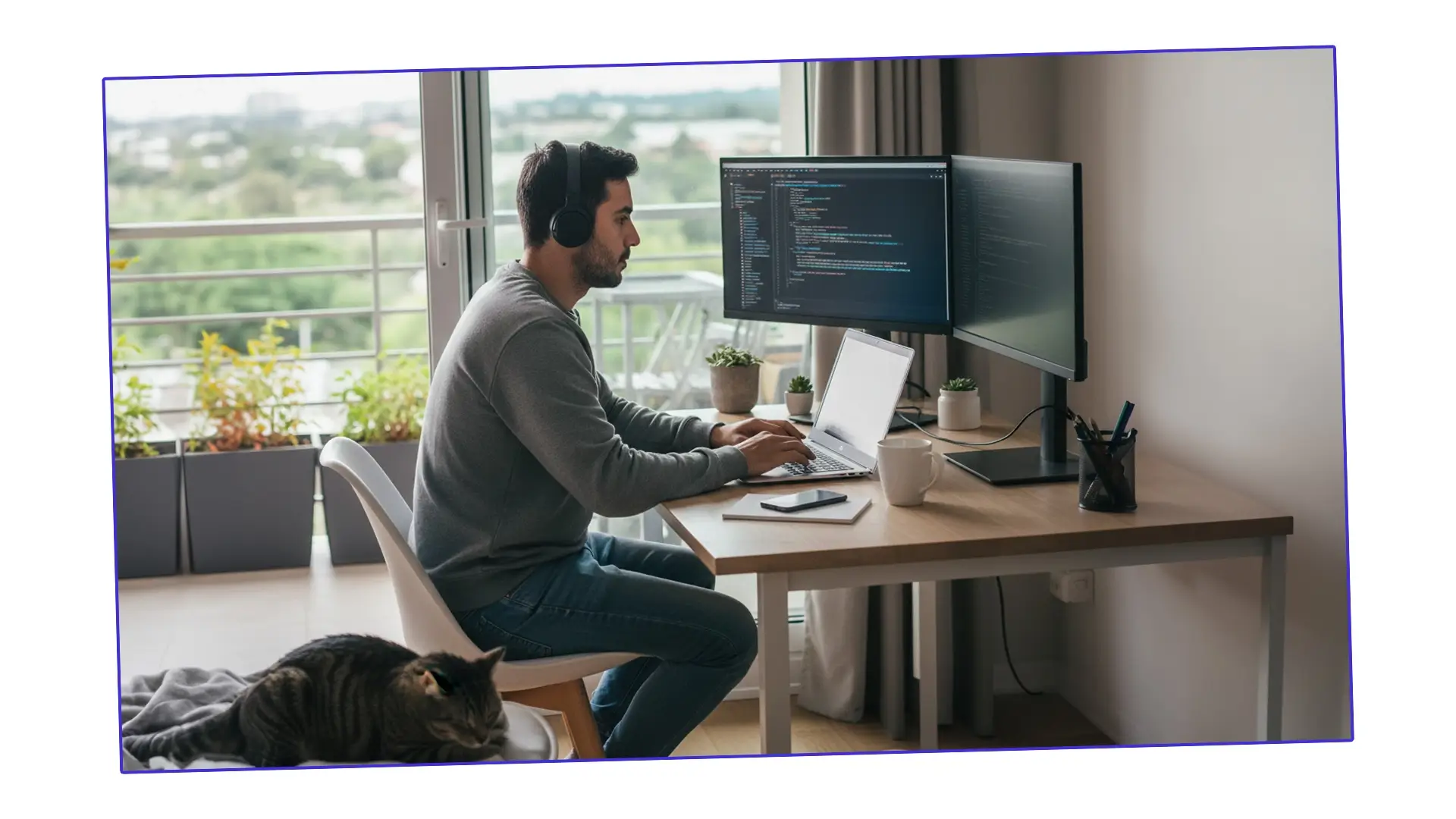
That happiness is also reflected in the data: 86% of our people describe our environment as happier and more supportive. Ana, from the People Department, has it clear: “What I like the most, I'd say the four-day work week and the great atmosphere. That's what really defines us.”
And better leadership plays a big part in that happiness. For Sandra, Marketing Manager, the extra day becomes priceless. Roles like hers - leading a team, managing projects, keeping the pace - rarely leave space to pause: “It’s like having a mini holiday every week,” she says,
Fridays no longer mean work. For Miguel, a Developer at Softquo, they mean growth: “I’ve started a training I never had time for before. Those extra days make it possible.”
In fact, our survey shows 44% of employees use their extra time for training, while others dedicate it to hobbies (55%) and travel (48%).
Responsibility begins with care
Being responsible with our people - giving them balance, rest and trust - is also being responsible with our company and the kind of workplace we want to build. And the proof is in how our teams have learned to make every hour count, People Director Paula explains: “This new methodology demands more organisation - both short and long term. It challenges you to be even more productive and manage your time better.”
For Cláudia, Social Media Specialist, Mondays start with a sharper focus. She’s learned to frontload her week, so nothing lingers until the last minute: “For me, the first three days’ boost is as valuable as the time for organisation on Thursdays.”
That same discipline shows up in design. Ángel, UI Designer, noticed how the shorter week forced him to prioritise: “I concentrate on the most important tasks and finish them within the four days.” His colleague Alba, Product Designer & UI Artist, has noticed it too: “Shorter goals, more achievable objectives.”
Even workflows have evolved. Pablo, Internal Communication Specialist, reshaped his day-to-day with a simple tool: “I applied the Eisenhower Matrix to evaluate what’s urgent and important. This way, I always finish the most time-sensitive tasks first.”
Every day, our employees show us that shorter weeks make them stronger - and that’s the responsibility we’ve chosen to uphold.